
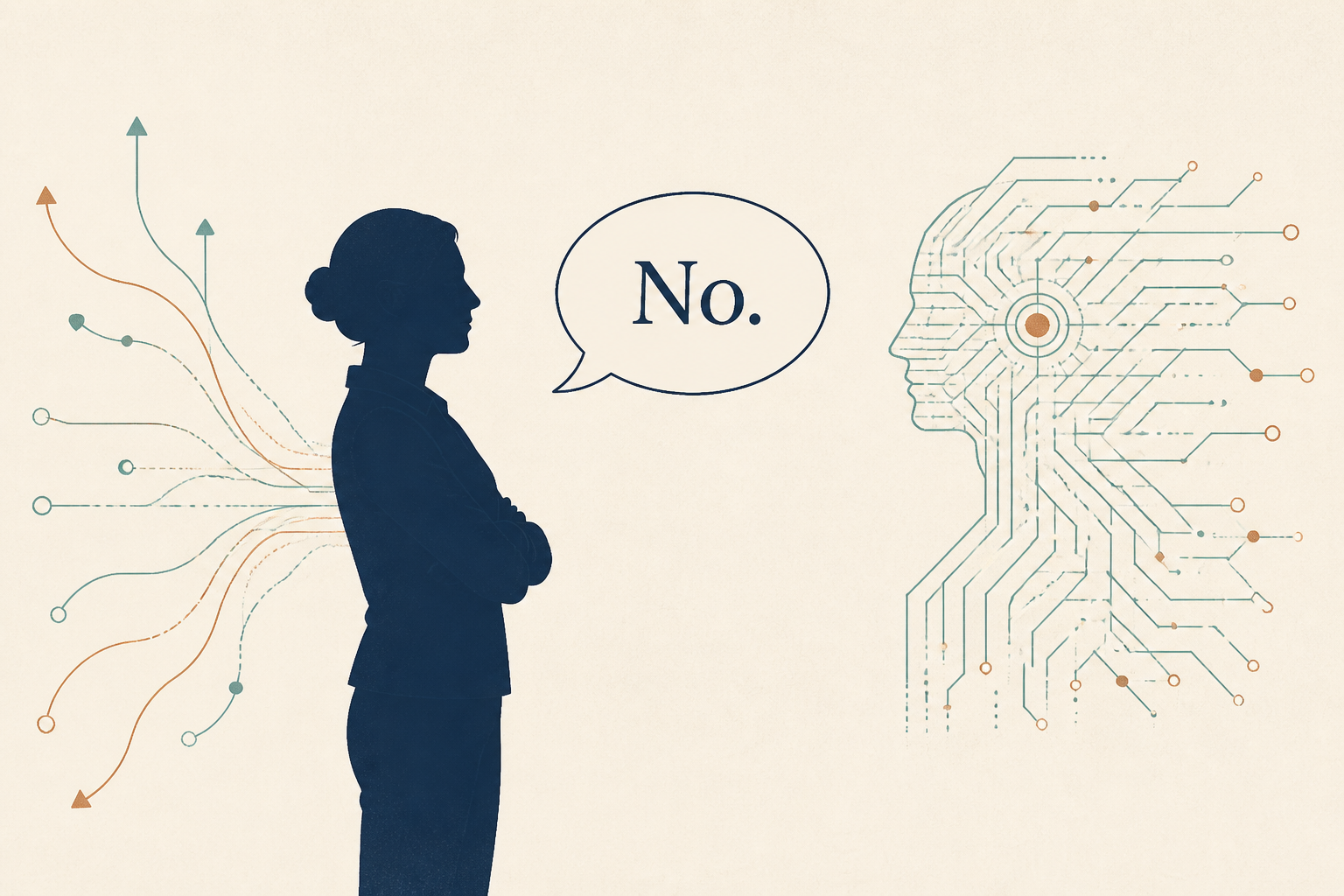
I think we're asking the wrong question about AI.
We keep asking what AI can do. Can it write? Sure. We can disagree on the quality but technically speaking, it fulfills the objective. Code? Analyze data? Build websites? Research? Automate this job or replace that one? Yes, on some level it does.
Perhaps the better question is:
What Can Humans Do Now That We Have AI?
I feel like I've been living this as an experiment for the past year. Because when I first began using AI, it was not to surrender myself to it. There's a subtle but enormously important difference between those two questions.
I use AI every day.
I've used it to build things I couldn't have built alone. I've learned subjects faster. I've pressure-tested business strategies and my own assumptions. I've analyzed problems from perspectives I wouldn't necessarily have considered. I've taken ideas that once would have required a team, technical skills I don't possess, or money I didn't have, and turned them into something real.
AI has given me more agency, not less.
But Here's the Important Part
I argue with it constantly.
I reject its recommendations. I question its assumptions. I verify important information. I tell it when it has missed the point. I decide what represents me and what doesn't. As my AI (whose name is Quillbert, Q, for short) will readily tell you, I've disagreed with 'him' 47 billion times so far. Which I gleefully intend to do into infinity. No human would ever put up with that (my ex-husband can testify to that).
I don't want or need AI to think for me.
Thinking for myself is the whole damn point.
And I think we're losing sight of that as organizations and individuals rush to adopt AI.
We're increasingly using technology not only to automate work, but to screen people, score people, monitor people, prescribe workflows, standardize decisions, and determine which humans deserve another human's attention.
We talk endlessly about whether AI will replace workers.
I'm becoming more concerned about something else:
Are We Redesigning Work Until Humans Behave Like Machines?
Follow the process.
Hit the metric.
Produce the output.
Don't question the architecture. Or the result. Or heaven forbid, the long-term outcome.
In other words: behave more like the machines we're supposedly worried will replace you.
And then we wonder why people are disengaged. How could they be anything else?
Technology Should Do the Opposite
AI should remove barriers between people and what they're capable of doing. It should give a nurse more time with patients. Give a small-business owner capabilities she couldn't afford to hire. Give an employee better information for making decisions. Give a creator the ability to execute an idea. Give an expert greater capacity to solve difficult problems.
The point of more powerful AI should be more powerful humans.
That suggests a question I think every organization implementing AI should be asking alongside ROI, efficiency, and productivity:
Does This Technology Increase Human Agency?
Does this technology increase human agency? Or does it reduce it? Heaven forbid, does it remove it entirely?
Does it give people greater capacity to exercise judgment, solve problems, create, learn, and make decisions?
Or does it make people increasingly subordinate to the system around them?
Those two organizations might look equally 'efficient' on a spreadsheet.
They will not be equally human.
AI Is a Tool. The Effectiveness Lives in How It's Used.
AI is a tool. We can debate endlessly the effectiveness of it. I personally believe the effectiveness lives within the way it's used.
But perhaps we need to stop elevating the tool and start paying more attention to the humans whose capabilities it was supposed to expand.
The future I want isn't one where AI becomes more human. It's one where humans become more capable and more genuinely human.
If this resonated, I'd love to hear from you.
Most of my work begins with a conversation. If something here mirrors what you're navigating, reach out — no pressure, no pitch.
Start a conversation