
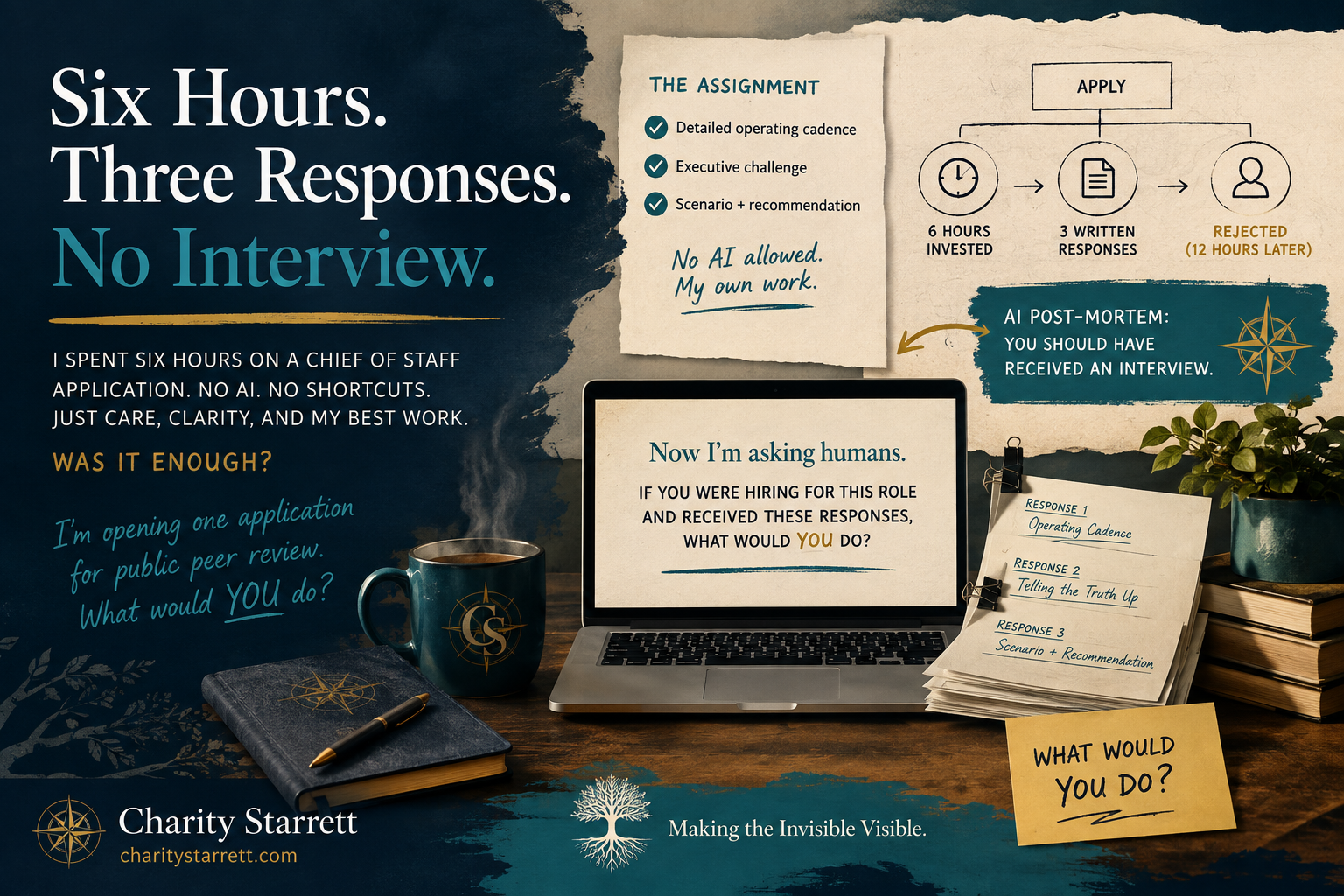
This past week I applied for a Chief of Staff role that I felt especially suited for. I have some rules around those applications. For any job above a certain threshold I spend the time doing research and customizing my response. The more I potentially like a role and company, the more time I invest into the process. And I really wanted this role. I spent six hours working on the application. _I was rejected within twelve hours._
The application through LinkedIn required answers to three questions. No AI generated responses. Which is fine, I always write my own answers. I’m an award-winning author so I try to use that to my advantage unlike other candidates who may need more help. The questions required a lot of work to answer. The first question alone required almost a forensic level of detail about an operation I’d run so using Google Docs, I drafted my responses. I figured I’d keep them for posterity, who knew what benefit they might give me long term?
I dove deep into the process of the role I’d fulfilled previously. As with many roles in the last ten years, I had found many ways to be of value and service to the organization. Eventually I was trusted with a lot of responsibility. So my response mapped out both the responsibilities and the achievements at a high level.
Here’s the opening and ending paragraph (the examples are not something I will make public):
Opening: I joined a company as an Executive Assistant for the COO. Within two weeks I was promoted to Director to help build out the franchise pipeline for national expansion. Then three months later I was promoted again to Executive Operations Manager answering to the founder directly. Within six months, I had positively impacted the operational cadence of the entire business through interventions within executive leadership, franchise development, commercial sales, accounting, operations, and revenue.
Ending: Collectively, these strategies provided critical infrastructure to help the business grow into an enterprise-level operation across three distinct layers of the organization simultaneously: the corporate executive leadership, which I helped develop, the national franchise operations, and the existing corporate store headquartered in San Antonio, Texas.
The second question was “Tell us about a time you told an executive something they didn’t want to hear. Tell us what you said and what happened”.
Of the three, this one was probably the easiest for me. I’m known professionally for my ability to speed truthfully, candidly, and professionally. You may not like what I have to say, but that’s really not my problem. The truth doesn’t care whether you like it or not. The truth is what it is. My job is to relay it professionally and let you decide. But it’s amazing how many people cannot handle that. Again, I give details I will not share publicly but the response was more than sufficient to show my integrity and communication style as well as the successful collaboration between the founder and three departments that led to strong outcomes for the company.
The final question was to talk about a specific scenario and how you would handle it. I didn’t save the exact question for that one. Now, I’m sensitive to providing a solution for free, but I honestly thought of all three answers, this one was my best response because I provided an architected overview of my intellectual process and communication approach without actually providing solutions. The automatic tendency with a question like that would be to provide a solution. I’m sorry, I require payment for that kind of labor. So I did the next best thing, I showed my process. And since this question is my own process and has nothing confidential in it, I can share the actual response as an example:
This is a service I offer called a strategic diagnostic where I analyze problems, symptoms, and constraints to identify potential solutions. I can provide an overview. Rapid transformations are actually my specialty. Two weeks is a reasonable timeframe, depending on the scale of the company and the problem.
I would first look at customer feedback. I would also review all five of the existing theories as clues needing evidence either for or against (because multiple theories can be true simultaneously). I would map the process from end to end along with the data around retention.
After the analysis is completed, I would make it understandable enough for an audience. I would communicate the problems, findings, and my recommended solutions as a plan for implementation. I am a big believer in always bringing a problem combined with potential solutions. It’s what I call my “Making the Invisible Visible” process. I’ve been doing that successfully for 20 years.
I call the last part the "Pick Your Pain" phase. Some organizations, in my experience, are ready to act toward a solution. Some are not. Sometimes there are budget constraints, capacity issues, or other variables. Often, it boils down to three things:
1 - We can't actually see the problem clearly enough to plan for and solve it.
2 - We now understand the problem and are choosing not to act right now.
3 - We understand the problem, have a plan, and are willing to act.
If, after review and discussion, the team has already made up its mind and cannot or won’t move toward a solution (either mine or a collectively agreed upon one), I will not try to force them. It must be mutually agreed upon, reciprocal, and include collaboration and trust. There must be commitment to staying flexible and adaptive as a plan unfolds and new information arrives. That, in the end, is sometimes the hardest part: reaching an agreed-upon commitment to act along with the trust to deploy solutions toward a goal.
I worked with horses for years, and there’s something you learn from working with those beautiful creatures. You can only lead a horse to water; you cannot make it drink. If it’s not thirsty, it will tell you. Or you can stand there and wait. So, in this instance, whatever the leadership team ultimately decides, I would respect, while staying open to alternatives that may arise later.
The reality is that sometimes life (and business especially) forces you to explore and be curious. Other times it requires you to find solutions and act. And then sometimes, life simply requires you to wait until the time is right. I’ve learned to recognize that each phase has value in its own way.
As a post-mortem after my rejection, I took my resume, my responses, and the job description to AI. I had it analyzed neutrally as a CEO of a major corporation and as an AI. The biggest risk I identified was my exceptional comfortability saying exactly what I think. But the AIs recommendation? High priority interview. Obviously, AI makes mistakes. But was that one? Or was that just the obvious conclusion based on the evidence?
I have plenty of theories about what could have gone wrong here. And this application in particular will not leave my mind. Partly because I have now probably done this in different ways for more than two dozen times for different roles with the same result. For many of the roles I customize for, I include a custom cover letter directly to the company directly connecting my experience to the role. And maybe everyone is doing this for theirs too, I don’t know. But it’s a lot of time, energy, and intellectual effort with almost zero return. Which makes it more than disappointing: it makes it a compounding waste of time. I am here to help companies solve real problems. I am exceptionally good at it. And yet the one problem I cannot solve is getting an interview. So is the problem me? Or the process?
After thirteen months and nearly 1,000 job applications, I no longer have any idea what I could be doing wrong. But I do know I’d really like to.
So to be clear here, I’m not asking whether the company did the right thing here in rejecting me. I’m asking a much simpler question: If you were hiring for a role and received these responses, what would YOU do?
Share This Essay
If this resonated, I'd love to hear from you.
Most of my work begins with a conversation. If something here mirrors what you're navigating, reach out — no pressure, no pitch.
Start a conversation