For a year now I've heard the same question over and over again: What are you looking for?
What a rich but impossible question that is!
The short answer: A place where I fit and can solve problems.
Simple right?
But really what does fit look like? What problems?
For me, fit is the hardest part because for most of my career it has required incredible contortions. Office politics. Interpersonal relationships. Conflicts. What happens when I do something amazing? What happens when things change because of me? What happens when I speak truth in a room that no one is prepared to hear? I also have PTSD so the contortions aren’t small for me, but they are often invisible to everyone around me.
What happens when someone doesn't like hearing the truth? What if that person happens to be in a position of power over me? Or in the organization? Because the truth just exists - it doesn't care how you feel about it. It's either true or false. There's not a lot of in between.
What I've learned over the years is there is a big difference between the amazing work I can do and the humans around that work. How they react to and perceive it. Even when it’s done with the best intentions, I cannot control how they perceive it.
I've seen both sides of this in businesses: the toxic response and the healthy one. The toxic response is an organization that can't handle any of the things I bring. A healthy one though? Oh, that's the magic. I've experienced it only a handful of times in my career.
The first was back in 2001 when I became a data analyst for AvMed Health Plan in Gainesville, Florida. It was post 9/11 but the fallout still hadn't fully arrived. I was doing database work helping to manage three massive health studies. I was Microsoft Access certified and doing work I genuinely loved. When I came in I could immediately see the databases were simply built wrong. The connections weren't there, so the data wasn't giving good information back. And within two weeks I went to my boss and I presented two options: I can try to fix what's here and it could take a very long time because I didn't build it and I can't guarantee I can reverse engineer every issue. Or I can start fresh, build it around the exact data we have now, and it'll be capable of holding and managing the data indefinitely going forward. I was terrified of how she might respond.
She authorized me to rebuild it from scratch. But I also knew if it didn't work, the consequences would be my job. That was very clear.
What came from that simple moment of trust was like watching a flower bloom. Within 90 days the databases were rebuilt and produced real data for the first time. In the meantime, our little unit of three became a cohesive team. We started asking questions and talking about the data. They kept presenting scenarios and I kept figuring out how to answer them with the data we had. I remember those chats fondly, the three of us just spit-balling ideas together and even though I was the youngest, newest team member, I felt like I belonged.
Then the breakthrough happened. We were sitting together one afternoon talking about our diabetes study and how all these people were hospitalized with all these serious issues. And I asked a question that changed everything: "What if we get to them before they're in the hospital?" Both of them looked at me and said, "How?"
And I formed a plan out loud: host an event where people could get screened completely for free for all the things we were seeing as outcomes: foot issues, vision issues, escalated insulin, lack of education, community resources. At that time, most diabetics were simply difficult to treat for any number of reasons. And then I said, "Most importantly, set it up so they get referred immediately for the care they need." No wait, no bureaucracy, no million tests. Just straight to care by a PCP.
And that's how we built the first-ever diabetes fair in Gainesville. Today, community diabetes screenings are commonplace. In 2001, they weren't.
What grew from there was beautiful and it took a full organizational effort. It absolutely wasn't something I did alone. But I can tell you the outcomes I heard about later. The doctors who called to tell us it was the best event they'd ever done and volunteered for the next one. The attendee I called for a survey who cried on the phone and said we saved her mother's life from an unknown heart issue identified at the event that led to further evaluation and treatment. A single intervention event led to positively impacting over 10,000 lives that year. And grew well beyond it after.
One of the best things about AvMed was that we trusted each other. We laughed together. We played. We spent time doing impossibly hard things. And we were the best of friends while we did it.
The other two studies dealt with pneumonia and cardiac arrest. We found interventions for pneumonia. But the cardiac study; I never could crack it. We found some things to intervene with but you can't undo a death. So by the time the study data got to me, it was too late. I could backtrack the data all day long and never get to the root cause. I meaningfully impacted 2 of the 3 but that one always stayed with me. Because it taught me something important: sometimes you're just too late and you have to start sooner in the chain, not at the end result.
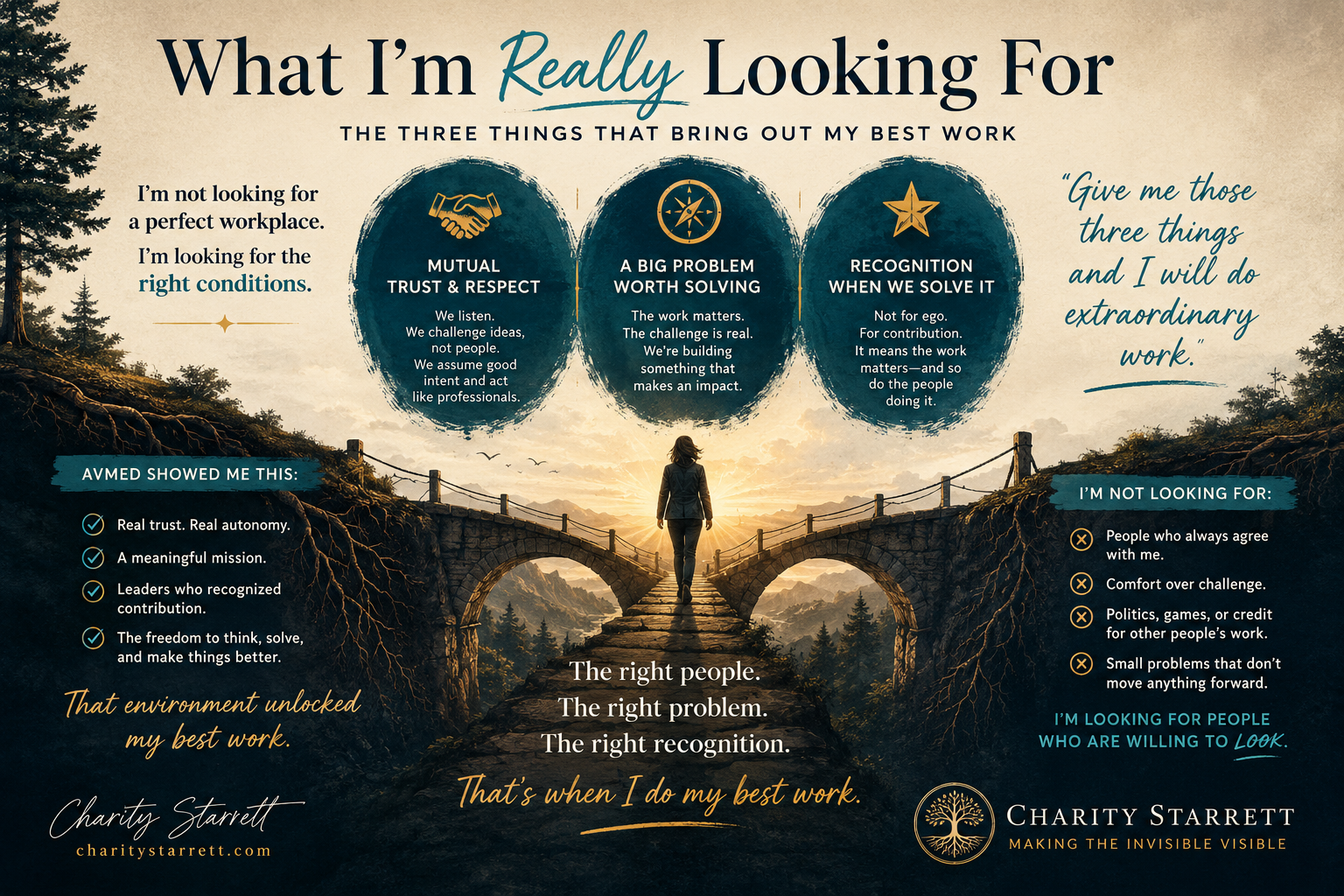
So when people ask me what I'm looking for, that’s the magic I remember. All the countless times I've done extraordinary things in my career. Where people simply trusted me to do the work. When I’ve been able to make a difference with a team. It's what I love to do. I can't put it any simpler than that. But the environment for that requires things: openness, trust, collaboration, curiosity, willingness. Probably a lot of other things - it's a long list. But at the heart of it? TRUST.
Performance isn't enough. I'm not looking for people who always agree with me. I'm looking for people who are willing to look. Ultimately I'm looking for a place where mutual trust and respect exist and we get to do amazing things together in service to others. I come completely alive when there's a perfect synergy between the work, the environment, and the results, when the work leads to visible accomplishments, recognition, and reward. THAT is what I'm looking for next.
Mutual trust and respect, a big problem worth solving, and recognition when we solve it. Give me those three things and I will do extraordinary work.
Share This Essay
If this resonated, I'd love to hear from you.
Most of my work begins with a conversation. If something here mirrors what you're navigating, reach out — no pressure, no pitch.
Start a conversation